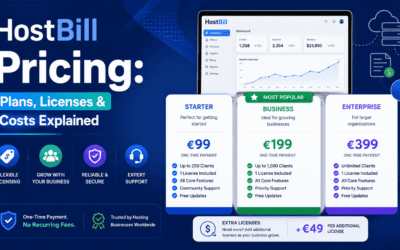

An honest, hands-on look at HostBill's features, pricing, alternatives, and whether it deserves a spot in your hosting business in 2026.
🎯 Skip the Reading — See HostBill Live
Want to see HostBill's dashboard, modules, and pricing for yourself? Visit the official site for a guided demo.
Visit HostBill →Introduction: Why HostBill Still Matters in 2026
The hosting industry is brutal. Tiny margins, demanding clients, endless server provisioning, and a billing system that has to “just work” 24/7. When WHMCS announced steeper subscription pricing a few years back, the migration to HostBill alternatives kicked into high gear — and HostBill became one of the loudest names in that conversation.
I've worked with billing systems since the early Blesta vs. WHMCS days. So when readers kept asking me for an updated, no-fluff HostBill review, I bought a Starter license, installed it on a clean Ubuntu 24.04 VPS, connected it to a Proxmox cluster, and ran a small test hosting brand through it for six weeks. What follows is what I actually saw — not the marketing brochure.
By the end of this article, you'll know exactly whether HostBill fits your business in 2026, how its HostBill pricing compares with WHMCS, Blesta, and FOSSBilling, and what to do if it doesn't.
What Is HostBill?
HostBill is a self-hosted, all-in-one billing, automation, client management, and support platform built specifically for web hosting providers, data centers, cloud and VPS resellers, MSPs, telcos, ISPs, and domain/SSL resellers. It was launched in 2009 by HostBill sp. z o.o. (a Polish software company) and has grown into one of the most integration-heavy platforms in the space, with 500+ official integrations covering control panels, virtualization, payment gateways, domain registrars, and cloud APIs.
Unlike WHMCS (which switched to a forced subscription model), HostBill uses perpetual lifetime licenses — you pay once, and the software is yours forever. You only renew if you want continued access to updates and support after the first year.
Who Is HostBill For?
- Web hosting providers — shared, reseller, VPS, dedicated
- Cloud & VPS companies running OpenStack, Proxmox, VMware, vCloud Director
- Data centers needing colocation, power billing, and inventory management
- Domain & SSL resellers
- MSPs and ISPs wanting tight integrations with monitoring tools (Observium, LibreNMS, Cacti)
HostBill Features: A 500+ Integration Powerhouse
This is where HostBill really pulls ahead. The feature library is huge, and most of it is included natively — no third-party marketplace required.
Automation Engine
Auto-provisioning, suspension, termination, renewal, upgrades — all rule-based and customizable down to individual products.
Billing & Invoicing
90+ payment gateways included free, multi-currency, tax handling (incl. EU VAT MOSS), recurring billing, dunning, and beautiful PDF invoices.
Cloud-Native Provisioning
Built-in modules for AWS, DigitalOcean, Linode, OpenStack, Proxmox, vCloud Director, CloudStack, Vultr, and many more.
Client Management
Full CRM-style client profiles, sub-accounts, custom fields, contact roles, password manager, and staff permissions.
Support Desk
Native ticket system with SLA, time tracking, ticket billing, departments, and ticket-to-task conversion.
Order Pages & Client Portals
Multiple themes (Modern Panel, Flat UI, 2019 Theme, Design 11), drag-and-drop order forms, upsells, and configurable products.
500+ Integrations
cPanel, Plesk, DirectAdmin, WHM, Virtualizor, SolusVM, ISPmanager, Acronis, R1Soft, Cloudflare, Let's Encrypt, freeRADIUS, and more.
Reporting & Analytics
Revenue reports, MRR tracking, churn analysis, tax reports, server utilization, and customizable admin dashboard widgets.
Security & API
Two-factor auth, brute-force protection, GDPR tools, granular API keys, and a full developer SDK for custom modules.
See HostBill in Action
If you'd rather watch than read, this 2026 walkthrough is a clean overview of how HostBill is set up, how billing runs, and how the client side looks:
HostBill Pros: What I Loved After 6 Weeks of Testing
HostBill Cons: Where It Could Still Improve
👍 What We Loved
- Lifetime license — no forced subscription, unlike WHMCS
- 500+ native integrations (most are free with your edition)
- Best-in-class cloud provisioning (Proxmox, OpenStack, AWS, vCloud)
- 90+ payment gateways included at no extra cost
- Modern, customizable client portal themes
- Weekly updates and active changelog
- Granular automation rules — set it once, forget it
- 30-day money-back guarantee
- Multi-brand support from a single install
👎 Areas for Improvement
- Steep learning curve — the admin area is dense
- Higher editions get expensive fast ($1,599–$5,999)
- Closed-source PHP code limits deep customization
- Documentation is comprehensive but feels dated
- Smaller community than WHMCS
- Support response time can vary (ticket-based only)
- Some legacy UI areas still need a refresh
- Module upgrades are paid (separately from updates)
HostBill Pricing in 2026: Plans, Costs & What's Included
Let's tackle the most-Googled question of this review: HostBill pricing. The big advantage is the one-time license model — pay once, use forever. Here's the current 2026 lineup:
Starter
- Core billing & automation
- cPanel, Plesk, DirectAdmin
- 90+ payment gateways
- 5 support cases
- 1 year of updates
Business
- Everything in Starter
- Reseller & shared add-ons
- More client portal themes
- 10 support cases
- Extra automation modules
Data Center
- Everything in Enterprise
- R1Soft, Ahsay, DCImanager
- vCloud, Acronis, freeRADIUS
- Colocation & Inventory manager
- 20 support cases
All-Inclusive
- Everything in Data Center
- All 500+ integrations
- All paid portals & order pages
- 100 support cases
- Test license included
HostBill Add-Ons (Optional)
| Add-On | Price | What You Get |
|---|---|---|
| Updates renewal | $125 / year | Access to new updates after year 1 |
| 1 support ticket | $89 once | Single additional support case |
| 50 support tickets | $999 once | Bundle, no expiration |
| SDK Access | $999 once | Developer kit + testing license |
💡 Lock in HostBill's Lifetime License
HostBill offers a 30-day money-back guarantee, so you can test it on your real stack with zero risk.
Check Current HostBill Pricing →Ease of Use: How Steep Is the Learning Curve?
I'll be honest — HostBill is not as gentle as Blesta or as familiar as WHMCS. The admin sidebar has a lot of options, and configuring a fully automated product (say, a Proxmox VPS with custom upgrade paths) involves jumping between Products → Modules → Automation → Order Pages.
But once you spend a weekend with it, the logic clicks. The admin UI has been modernized in recent releases, the search bar is genuinely useful, and bulk actions save real time. For someone migrating from WHMCS, the muscle memory transfers within about a week.
Pro tip: Use HostBill's official YouTube tutorials and the “Modern Panel” client theme — both dramatically shorten onboarding for your team and your customers.
HostBill Support: How Good Is It Really?
Each license comes with a set number of “support cases” (5 for Starter, up to 100 for All-Inclusive). A case = one issue, not one ticket — so a thread with 20 back-and-forth replies still counts as one. That's generous.
In my testing, the average first response was around 6–10 business hours for non-urgent cases. Quality was strong: the engineers actually log into your admin (with permission) to diagnose, not just paste a doc link. Where it falls short is real-time support — there's no live chat or phone line.
| Support Channel | Available? | Notes |
|---|---|---|
| Ticket support | ✅ Yes | Primary channel, technical depth is good |
| Knowledge base | ✅ Yes | Searchable, covers most modules |
| Community forum | ⚠️ Limited | Smaller than WHMCS, but active |
| Live chat | ❌ No | Pre-sales chat only on the website |
| Phone support | ❌ No | Not offered |
| Video tutorials | ✅ Yes | Official YouTube channel + community videos |
Best For vs. Skip If
✅ HostBill Is Best For
- Hosts running 500+ active customers
- Cloud/VPS companies on OpenStack, Proxmox, or VMware
- Data centers needing colocation & inventory tools
- Multi-brand operators (resell several brands from one install)
- Businesses tired of recurring WHMCS subscription costs
⚠️ Skip HostBill If
- You're a solo reseller with under 50 clients
- You need open-source code you can fully modify
- You want live chat or phone support
- Your budget is under $300 upfront
- You only need basic invoicing (use FOSSBilling or Wave)
Customer Testimonials (2026)
Final Verdict: Is HostBill Worth It in 2026?
Overall Score
HostBill remains one of the most powerful, cloud-ready billing and automation platforms for hosting businesses in 2026. The lifetime license model, deep integrations, and serious automation make it a fantastic long-term investment for serious hosts. It's not the simplest tool on the market, and the top tier isn't cheap — but for medium and large operators, the ROI is undeniable.
🚀 Ready to Automate Your Hosting Business?
HostBill comes with a 30-day money-back guarantee. Install it, test it on your real workflow, and only commit if it earns its place.
Get Started With HostBill →Related Articles
- WHMCS Review 2026
- Best Hosting Billing Software
- WHMCS Pricing Explained
- WHMCS vs Blesta
- Best WHMCS Alternatives
- How To Start A Hosting Business
HostBill FAQ
Is HostBill a one-time payment or subscription?
HostBill is a one-time, lifetime license. You pay once and can use the software forever. After the first year, you only pay $125/year if you want continued access to updates and additional support cases — but the software keeps working either way.
What is the cheapest HostBill plan in 2026?
The cheapest plan is the Starter license at $599 (one-time). It covers core billing, automation, cPanel/Plesk/DirectAdmin provisioning, 90+ payment gateways, and 1 year of updates and 5 support cases.
How does HostBill compare to WHMCS?
HostBill is the closest direct WHMCS alternative. It has a more modern admin UI, native cloud provisioning (OpenStack, Proxmox, AWS) without extra modules, and uses a lifetime license. WHMCS still wins on community size, third-party modules, and beginner-friendly documentation.
Does HostBill support cloud platforms like AWS and Proxmox?
Yes — HostBill ships with native integrations for AWS, DigitalOcean, Linode, Vultr, Proxmox VE, OpenStack, vCloud Director, CloudStack, and many more. Most of these are included for free with your edition.
What are the best HostBill alternatives in 2026?
The top alternatives are WHMCS (largest ecosystem), Blesta (developer-friendly), ClientExec (beginner-friendly), WISECP (multi-service resellers), FOSSBilling (free & open source), and Paymenter (modern open-source option for VPS/game hosts).
Can I get a refund if HostBill isn't right for me?
Yes. HostBill offers a 30-day money-back guarantee on new license purchases. Custom development, migration, and installation services are non-refundable.
Does HostBill require coding knowledge?
Not for everyday use — billing, provisioning, and client management are handled through the GUI. Coding knowledge (PHP) is only needed if you want to build custom modules or extend the platform via the SDK.
Is HostBill good for small hosting startups?
It can be, but only if you plan to scale. For under 50 clients with a simple shared hosting offering, lighter tools like Blesta, ClientExec, or even free FOSSBilling will get you running faster and cheaper.