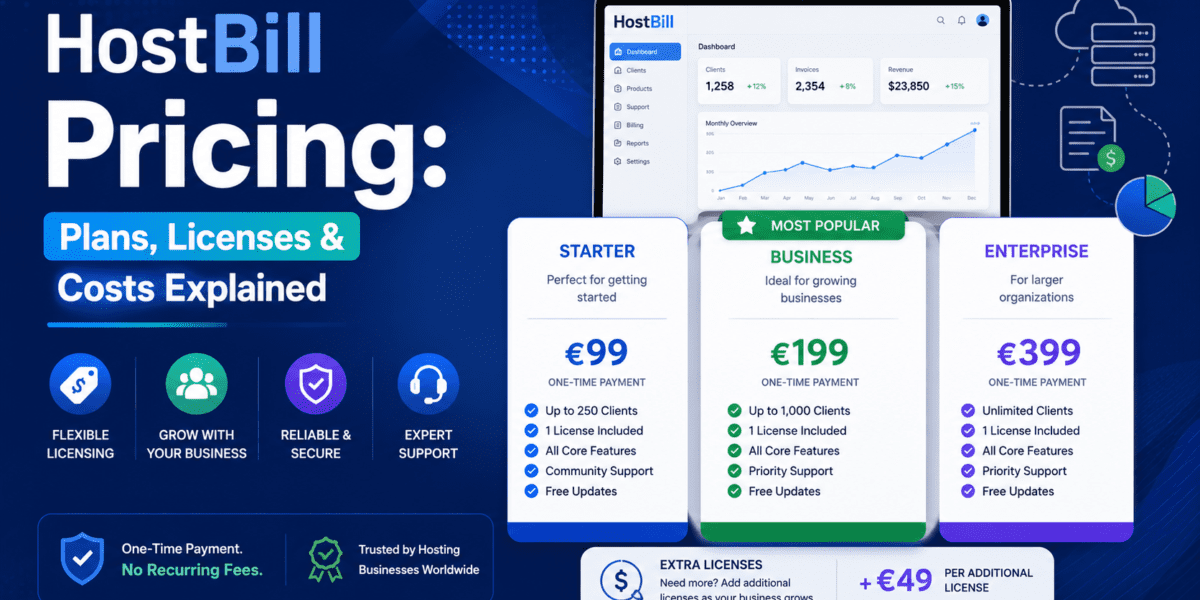
If you're shopping for hosting billing software in 2026, HostBill pricing is probably the first thing you want to nail down before you commit. The short answer: HostBill is sold as a one-time, lifetime license with four editions ranging from $599 to $5,999, plus optional yearly updates at $125 and per-module add-ons. There is no monthly SaaS plan, no per-client fee, and no “active user” tax — which is exactly what makes it different from WHMCS.
HostBill Pricing at a Glance (2026)
Unlike most modern SaaS billing tools, HostBill uses an old-school but increasingly attractive model — you buy HostBill once, you own it forever. Here are the current 2026 tiers as confirmed on the HostBill official website:
Startup
- Core HostBill features
- 10 support cases
- cPanel, Plesk, DirectAdmin
- DigitalOcean, Linode, Vultr
- Stripe, PayPal & major gateways
- 1 client portal + order page
Enterprise
- Everything in Startup
- 15 support cases
- Virtualizor, SolusVM, Proxmox
- Acronis, JetBackup, Plesk Onyx
- vCloud, OpenStack, CloudStack
- Multiple paid client portals
Data Center
- Everything in Enterprise
- 20 support cases
- R1Soft, Ahsay, DCImanager
- Noc-PS, Cacti, Observium, LibreNMS
- Colocation & Inventory Manager
- Staff AD/LDAP, Password Manager
All-Inclusive
- Everything in Data Center
- 100 support cases
- All hosting integrations
- All apps & extensions
- All paid client portals
- Additional license for testing
All prices are USD net. VAT may apply for EU buyers. Each license includes 1 year of free updates and access to support.
One-Time vs Monthly: How HostBill Licensing Actually Works
This is the question I get most often from people comparing platforms: “Is HostBill monthly or one-time?”
HostBill is one-time only. There is no monthly HostBill plan, no rental option, and no SaaS-hosted version (unlike WHMCS, which now pushes a Cloud plan). You purchase the license, install it on your own server, and run it indefinitely — even if you never pay another cent to HostBill.
The catch is what stops being included after year one. Here's the honest breakdown:
| What You Get | Year 1 (Included) | Year 2+ (Optional) |
|---|---|---|
| Use the software | ✅ Yes | ✅ Yes (forever) |
| All modules in your edition | ✅ Yes | ✅ Yes (frozen version) |
| Software updates & patches | ✅ Yes | 💰 $125/year |
| Support tickets | ✅ Edition bundle (10–100) | 💰 $89 each or $999/50 bundle |
| Major version upgrades | ✅ Yes | 💰 Discounted for existing clients |
| 30-day money-back guarantee | ✅ Yes | — |
In practice, most hosts I work with keep the $125/year updates active because security patches and integration fixes (especially for cPanel, Stripe, and Proxmox) ship throughout the year. It still works out to roughly $10/month equivalent for an Enterprise license over five years — substantially cheaper than competing SaaS plans.
What's Included at Each HostBill License Tier
Every HostBill license shares the same core engine: automated billing, invoicing, client management, support tickets, order pages, an API, two-factor authentication, multi-currency, tax handling, and the developer SDK. What changes between tiers is the list of bundled integrations — i.e., which control panels, virtualization platforms, backup services, and add-on apps you get without paying separately.
Startup ($599) — Best for new hosting startups
Targeted at solo founders and small shared-hosting resellers. You get cPanel, Plesk, DirectAdmin, plus the major cloud providers (DigitalOcean, Linode, Vultr, Hetzner Cloud, Lightsail). Payment gateways like Stripe, PayPal, and 2Checkout are baked in. If your business is shared hosting with a single control panel, this tier is genuinely all you need.
Enterprise ($999) — Best for growing hosts & cloud/VPS providers
This is the tier I recommend to 70% of new HostBill buyers. It adds the VPS-heavy integrations: Virtualizor, SolusVM, Proxmox, OpenStack, CloudStack, vCloud Director, plus Acronis and JetBackup. If you sell anything that runs on a virtual machine, this is your floor.
Data Center ($1,599) — Best for managed service providers
You only need this if you're running real infrastructure — backup automation (R1Soft, Ahsay), data-center tools (DCImanager, Noc-PS), monitoring stacks (Cacti, Observium, LibreNMS), and enterprise client features like AD/LDAP authentication, password manager, and colocation/inventory tracking. Niche but powerful.
All-Inclusive ($5,999) — Best for large hosts who want everything
Every current and existing integration, every paid client portal, every paid order page, plus 100 support tickets and a free test license. The price tag looks steep until you realize buying individual high-end modules à la carte easily passes $8,000–$10,000. If you're an established host adding 5+ paid modules anyway, this pays for itself.
HostBill Add-On Costs (Modules, Support & Updates)
Here's where buyers get surprised: even on the Enterprise license, anything not bundled in your edition is sold separately. New modules released after your purchase are also not auto-added — even on All-Inclusive. Below are the documented add-on costs as of mid-2026:
Access to Updates Renewal
after year 1$125/yr1 Extra Support Ticket
single issue$8950-Ticket Bundle
no expiration$999SDK Access
+ test license$999Individual Modules
e.g. Order Quotefrom $99Premium Modules
e.g. Hosted.aifrom $399Custom Development
per projectQuoteEdition Upgrade
e.g. Startup → EnterprisePay diffA real-world example from a client I helped onboard last month: they bought the Enterprise edition ($999), added the Hosted.ai GPU billing module ($399 one-time), kept updates active ($125/yr), and that was it. Total year-one cost: $1,523. Year two: $125. Compare that to a comparable WHMCS Cloud plan at ~$75/month and the math tilts hard toward HostBill once you cross the 18–24 month mark.
HostBill Pricing vs WHMCS Pricing — Quick Comparison
⚖️ HostBill vs WHMCS: The TL;DR
WHMCS is a monthly subscription tied to your active client count — starting at $9.99/month (Starter Cloud, 25 clients) and climbing past $84.95/month for Business self-hosted with unlimited clients. The total stacks up every single month, forever.
HostBill is a one-time license with no client limits. You pay $599–$5,999 once, and active client count never affects your bill.
📖 Full breakdown here: WHMCS Pricing 2026 · WHMCS vs HostBill Comparison
| Factor | HostBill | WHMCS |
|---|---|---|
| Pricing model | One-time lifetime | Monthly subscription |
| Entry price | $599 once | $9.99/month |
| Top tier | $5,999 once | $84.95+/month |
| Client limits | Unlimited on all editions | Tied to plan (25–unlimited) |
| Updates | 1 yr free, then $125/yr | Included in monthly fee |
| Modules | Bundled by edition + paid extras | Mostly paid add-ons |
| 5-year total (mid-tier) | ~$1,499 | ~$3,300+ |
The break-even point typically lands at 14–18 months for a mid-sized host. After that, HostBill is dramatically cheaper. The trade-off is the steeper learning curve and the fact that WHMCS still has the larger third-party marketplace.
Performance & Value: What Your Money Actually Buys
I've installed HostBill for clients ranging from 3-server VPS shops to a 40,000-customer European hosting company. Across the board, the things people consistently get value from are:
- 500+ native integrations — cPanel, Plesk, DirectAdmin, Virtualizor, SolusVM, Proxmox, AWS, DigitalOcean, Cloudflare, Let's Encrypt, freeRADIUS, and more.
- 90+ payment gateways — Stripe, PayPal, Authorize.net, Razorpay, regional gateways for India, Brazil, EU, Australia.
- Cloud-native provisioning — full lifecycle automation for AWS, OpenStack, vCloud Director, CloudStack, Vultr, Linode.
- Reporting & MRR tracking — revenue, churn, tax, server utilization, all built in.
- Security stack — 2FA, brute-force protection, granular API keys, GDPR tools.
For a deeper feature-by-feature evaluation, see my full HostBill Review — it covers performance, the admin UI, real-world support response times, and includes screenshots.
Pros and Cons of HostBill Pricing
✅ What We Love
- True lifetime ownership — no monthly bills
- No active-client caps on any edition
- Massive integration library bundled by tier
- 30-day money-back guarantee
- Optional updates — keep using old version free
- Pays back vs WHMCS in ~18 months
- Strong cloud/VPS automation
❌ Areas to Watch
- Higher upfront cost (psychological barrier)
- New modules released later cost extra
- Support is paid per-ticket after bundle
- Steeper learning curve than WHMCS
- Smaller third-party theme marketplace
- $125/yr updates fee feels nickel-and-dimey
HostBill Demo & Free Trial Options
Officially, there is no traditional 14-day free trial of the admin software. However, there are three ways to evaluate HostBill at zero or low risk:
- HostBill demo — request a live demo through the HostBill official website contact form. A solutions engineer walks you through the admin and client area.
- 30-day money-back guarantee — buy the lowest tier, deploy it, and if you don't like it within 30 days, claim a full refund (license cost only).
- Sandbox via support — existing customers can request a free test license to try features before deploying to production.
For a guided walkthrough, this video tutorial covers a real HostBill demo and setup flow:
Is HostBill Worth It? My Verdict
HostBill Pricing Verdict
HostBill is absolutely worth it if you're a hosting business planning to operate for at least 18+ months. The lifetime license model, unlimited clients, and bundled integrations deliver real long-term value that recurring SaaS pricing simply cannot match. The Enterprise edition at $999 is the smartest entry point for most growing hosts. Skip it only if you need WHMCS-specific themes/modules or want the lowest possible first-month cost.
🚀 Get Started with HostBill“After 14 months on WHMCS, we switched to HostBill Enterprise. The one-time $999 was painful in the moment — but we've already saved over $600 versus our old WHMCS Professional plan, and we still own the license forever.” — Mateusz K., cloud VPS provider, March 2026.
Where to Buy HostBill (2026)
HostBill is sold exclusively through the HostBill official website and their client portal. There are no authorized resellers, no Amazon listings, and no third-party discount stores. Beware of any site claiming to sell discounted HostBill licenses — they are almost certainly nulled/pirated and will leave you without updates or support.
Legitimate ways to save money on HostBill pricing:
- Watch for Black Friday and Cyber Monday promos (typically 10–15% off).
- Upgrade later instead of buying All-Inclusive upfront — you only pay the price difference.
- Use the 50-ticket bundle ($999) instead of paying $89 per ticket if you anticipate ongoing support needs.
- Skip the SDK Access ($999) unless you actually plan to build custom modules.
FAQ: HostBill Pricing
How much does HostBill cost in 2026?
HostBill costs between $599 and $5,999 as a one-time payment. The four editions are Startup ($599), Enterprise ($999), Data Center ($1,599), and All-Inclusive ($5,999). Each includes 1 year of free updates and support tickets. After year one, updates renew at $125/year (optional).
Is there a free HostBill trial or demo?
HostBill does not offer a traditional free trial of its software. However, you can request a live HostBill demo from their official website, and every license is covered by a 30-day money-back guarantee — effectively a risk-free trial. Existing clients can also request a free test license through support.
Is HostBill monthly or one-time payment?
HostBill is one-time only. There is no monthly subscription option. You buy the license once and own it for life. Optional updates renew at $125/year after the first year, but the software keeps working forever even if you skip renewals.
Which HostBill edition should I buy?
For most growing hosts and VPS providers, the Enterprise edition at $999 is the sweet spot — it includes Virtualizor, SolusVM, Proxmox, OpenStack, and other essential cloud integrations. Startup is fine for shared-hosting-only shops, while All-Inclusive only makes sense if you plan to use 5+ premium modules.
Can I upgrade my HostBill license later?
Yes. You can upgrade to a higher edition at any time and only pay the price difference. So buying Startup today and moving to Enterprise next year costs an additional ~$400, not a fresh $999.
Is HostBill cheaper than WHMCS?
Over 18+ months, yes — significantly. WHMCS costs $25–$85+ per month forever, while HostBill is a single payment. A 5-year comparison typically shows HostBill saving $1,500–$2,500. See the full WHMCS Pricing breakdown and the WHMCS vs HostBill comparison for exact numbers.
Does HostBill include support?
Yes — each edition includes a support-ticket bundle (10 for Startup, 15 for Enterprise, 20 for Data Center, 100 for All-Inclusive). Additional tickets cost $89 each, or you can buy a 50-pack for $999 with no expiration date.
Final Thoughts on HostBill Pricing
If you're serious about running a hosting business in 2026 and beyond, HostBill's one-time pricing model is one of the last great deals left in SaaS-dominated software. The upfront cost stings, especially if you're used to $10–$25/month SaaS tools, but every month you keep using it past month 18 is essentially free. Combined with unlimited clients and a genuine ownership model, this is the right choice for any host with a multi-year time horizon.
For a deeper look at how HostBill actually performs day-to-day (admin UI, automation flows, support quality), read the full HostBill Review. If you're still cross-shopping, the WHMCS vs HostBill guide will help you make the final call.