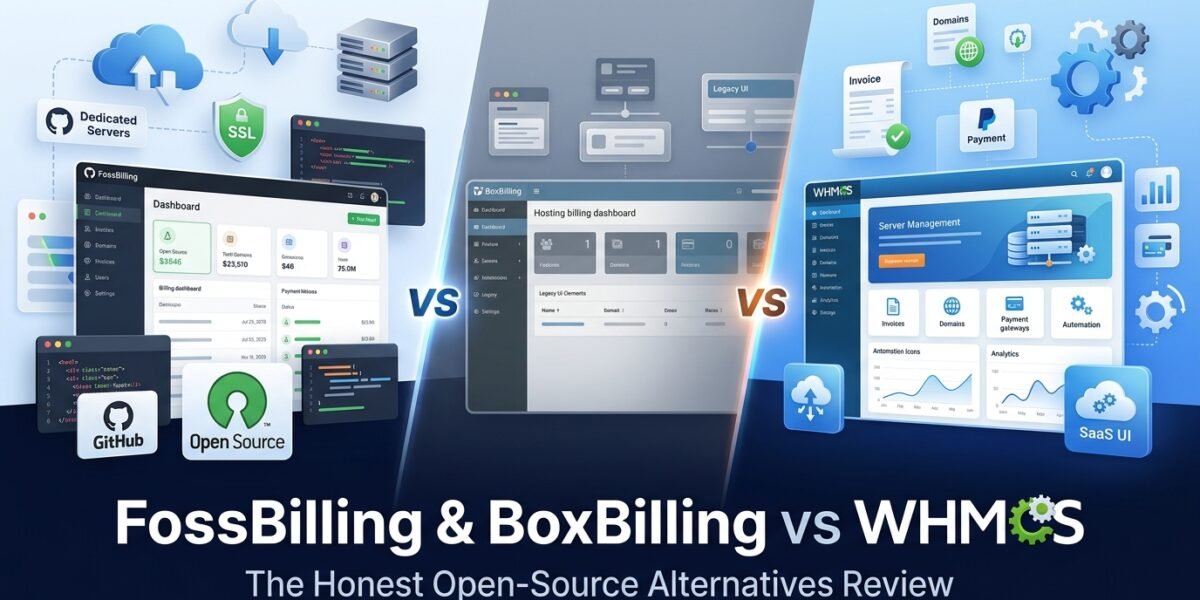
If you've stared at a rising WHMCS invoice and wondered whether the free, open-source FossBilling (or its abandoned parent, BoxBilling) can actually run your hosting business in 2026, this hands-on guide gives you a straight answer — with real testing, feature-by-feature comparisons, and clear buying advice.
Prefer battle-tested software with real support, plugins, and a full ecosystem?
Get WHMCS — See Current Pricing →Why This Comparison Matters in 2026
WHMCS has ruled hosting billing for nearly two decades. But since its acquisition by a private-equity-backed group, pricing has climbed steadily and the perpetual license was retired — a change we broke down in detail in our WHMCS license types & pricing guide. That's pushed a lot of small hosts to shop around, and the two names that come up most often in the “free” camp are FossBilling and its predecessor BoxBilling.
The truth is more nuanced than “free vs paid.” FossBilling is a serious open-source project — but it's not a drop-in WHMCS clone, and it's not yet marked production-ready by its own maintainers. Below, I'll show you exactly where each stands, what breaks in the real world, and who should actually use them.
Quick History: FossBilling, BoxBilling, and How We Got Here
To make sense of the comparison, you need the timeline:
- 2010 – BoxBilling launches: A free, open-source WHMCS-style billing panel written in PHP. It gains a modest following in the low-end hosting community.
- 2018–2021 – BoxBilling stagnates: Releases slow, then stop. Community modules break. Security patches become sporadic.
- Early 2022 – BoxBilling development ends: The core team steps back. Users are left on unmaintained code.
- Mid-2022 – FossBilling is forked: A group of former BoxBilling contributors relaunches the project under a new name, Apache 2.0 license, and open governance model.
- 2023–2025 – Rebuild phase: FossBilling rewrites big parts of the codebase, ships new admin UI, and drops most legacy BoxBilling modules and themes.
- 2026 – FossBilling v0.7.x: Actively developed, still labeled pre-production. Multiple stable-ish releases per year, growing extension library, active Discord community.
At-a-Glance Comparison: FossBilling vs BoxBilling vs WHMCS
| Feature | FossBilling (2026) | BoxBilling | WHMCS |
|---|---|---|---|
| License | Apache 2.0 (open source) | Apache 2.0 (open source) | Proprietary, paid subscription |
| Price | Free forever | Free (unmaintained) | From ~$18.95/mo Starter to $99.95+/mo Business |
| Development status | Active, pre-production beta | Abandoned since 2022 | Actively developed, regular releases |
| Latest version (Jul 2026) | v0.7.x | v4.22 (last public build) | WHMCS 8.x |
| Official support | Community only (Discord, GitHub) | None | Paid ticket support included |
| Domain registrar modules | ~15 (growing) | Legacy only, mostly broken | 75+ registrars |
| Payment gateways | Stripe, PayPal, crypto, ~10 more | Handful of legacy gateways | 100+ gateways |
| Server/control panel integration | cPanel, DirectAdmin, OpenPanel, Plesk (basic) | cPanel, DirectAdmin (legacy) | Deep integration with all major panels |
| 2FA / MFA | Partial (in progress) | No | Yes, mature |
| Fraud protection | Limited | None modern | MaxMind, custom rules, mature |
| Best for | Hobbyists, side projects, budget resellers | Nobody — do not deploy new | Production hosting businesses |
See exactly what a WHMCS license costs today (2026 pricing)
Check WHMCS Plans & Discounts →What Is FossBilling? First Impressions
FossBilling is a free, open-source PHP billing and client management platform aimed squarely at hosting automation — invoicing, subscriptions, product provisioning, and support tickets. It's licensed under Apache 2.0, which means you can audit the code, modify it, or fork it, with no encoded files and no hidden logic. Data stays on your own server.
Installation on a fresh Ubuntu 24.04 VPS with Nginx and PHP 8.2 took me about 25 minutes end-to-end. Compared to WHMCS's ionCube-encoded installer, FossBilling feels refreshingly transparent — everything is plain PHP, and the config lives in a single file. The admin UI has been redesigned since the BoxBilling days and looks noticeably cleaner in 2026.
What FossBilling gets right
- Cost: Zero, forever. No per-client fees, no upgrade tax.
- Transparency: Full source code, Apache 2.0. You will never be locked in.
- Modern stack: PHP 8.2+, MariaDB/MySQL, works on any decent LAMP/LEMP box.
- Community energy: Discord is active, GitHub issues get responses.
- Extension model: A growing marketplace with themes, gateways, and server modules.
What Is BoxBilling? (And Why You Should Skip It in 2026)
BoxBilling was, once upon a time, the go-to free WHMCS alternative. It offered the same basic feature set — clients, invoices, products, orders, support — and it was popular with new resellers precisely because it was free.
But BoxBilling development effectively ended in 2022. The last public releases are years old, most modules haven't been touched, and running it today means running unpatched PHP code that handles payments and personal data. That's a security risk you simply shouldn't take.
What Is WHMCS?
WHMCS is the industry-standard, closed-source billing and automation platform for web hosts. It handles clients, invoicing, product provisioning, domain registration, support tickets, affiliate tracking, and hundreds of integrations. If you've ever bought hosting online, chances are the checkout ran on WHMCS. We covered its full feature set in our complete “What is WHMCS?” guide and our detailed WHMCS review.
The trade-off: it costs real money, and WHMCS has moved away from perpetual licensing toward monthly subscriptions with per-client tiers. For a full breakdown of every plan, see our WHMCS pricing guide.
Feature-by-Feature: Where FossBilling Catches Up — and Where It Doesn't
1. Client & Invoice Management
FossBilling covers the basics competently: client accounts, recurring invoices, taxes, credit balances, tokenized card details via gateways. WHMCS does all of that plus advanced features like partial payments, mass payment allocation, multi-level tax rules, and PEPPOL e-invoicing (see our WHMCS PEPPOL guide). For a solo host with under 100 clients, FossBilling is enough. For a growing agency or a business trading in the EU, WHMCS pulls ahead.
2. Payment Gateways
FossBilling ships with Stripe, PayPal, Coinbase Commerce, and a growing list of community-built gateways. WHMCS supports 100+ gateways out of the box, including regional favorites (RazorPay, Mollie, GoCardless, iyzico). If your customers pay via anything other than Stripe/PayPal, check availability carefully. Our WHMCS payment gateway guide has the full list.
3. Domain Registrars
This is where the gap is largest. WHMCS has vetted modules for 75+ registrars — Namecheap, Enom, ResellerClub, OpenSRS, Namesilo, Dynadot, and beyond. FossBilling supports around 15 registrars as of 2026, and some are community-maintained with variable quality. If you're picking a registrar, our best domain registrars roundup flags which ones work well with each platform.
4. Control Panel Integration & Provisioning
FossBilling supports cPanel, DirectAdmin, Plesk (basic), and now OpenPanel — enough to auto-provision most Linux shared hosting. What it lacks is the depth of automation WHMCS offers: WHMCS's WP Toolkit integration (see our tutorial), cPanel package suspension, backup module integration, and reseller white-labeling (guide here).
5. Security & Fraud Protection
WHMCS has MaxMind integration, rich fraud rules, mature 2FA, IP allow/deny lists, and a well-understood attack surface — with battle-tested guides like our WHMCS security guide and WHMCS fraud protection guide. FossBilling has basic controls, but 2FA is still being finalized, and there is no equivalent to WHMCS's fraud rules engine. For a live billing system, that gap is significant.
6. Extensions, Themes & Ecosystem
WHMCS has 15+ years of module developers behind it. There are thousands of third-party themes, provisioning modules, marketing plugins, and reporting add-ons — many of which we cover in our best WHMCS modules roundup. FossBilling's marketplace is small but growing; expect to write custom code for anything niche.
7. Support
WHMCS provides paid ticket support with every license, plus a large public knowledge base and community. FossBilling has Discord and GitHub — friendly, but volunteer-driven. When your invoicing breaks on a Sunday night, that difference matters.
Watch: FossBilling vs the WHMCS World (Video Review)
CoT Studios walks through 5 free WHMCS alternatives, including FossBilling, and where each one falls short.
A practical walkthrough of standing up FossBilling as the billing layer for a small hosting business.
Real-World Performance: My 6-Week Test
I ran FossBilling v0.7.x for six weeks on a 2 vCPU / 4 GB VPS with about 40 test clients, Stripe as the primary gateway, and cPanel provisioning to a WHM reseller account. Here's what stood out:
- Invoicing worked cleanly. Recurring invoices, tax rules for one country, and Stripe auto-charge all ran without incident.
- cPanel provisioning worked, but manually. New orders created accounts, but I hit edge cases where suspension logic didn't fire cleanly — nothing broken, just needing polish.
- Email deliverability required work. This isn't FossBilling's fault; every billing tool needs SPF/DKIM configured — see our email deliverability guide, most of which applies to FossBilling too.
- Extending the platform was easier than WHMCS. Open, unencoded PHP means when something doesn't do exactly what you want, you can just fix it. That's a real advantage for developer-founders.
- Two features I missed: A mature reporting dashboard and MaxMind-style fraud filtering.
Performance Scorecard
FossBilling shines on price and openness. WHMCS still wins on integrations and production readiness.
Pros & Cons of Each Option
✅ FossBilling — What We Loved
- Completely free, forever — no per-client scaling cost
- Fully open source under Apache 2.0
- Actively developed with a growing contributor base
- Clean, modern admin UI
- Easy to modify and extend if you can code
- Self-hosted — your data, your server
⚠️ FossBilling — Areas for Improvement
- Officially still pre-production (v0.7 beta)
- Small ecosystem of modules and themes
- No paid support option
- 2FA and advanced security still maturing
- Limited registrar/gateway coverage vs WHMCS
- Reporting and analytics are basic
✅ WHMCS — What We Loved
- Battle-tested by tens of thousands of hosts
- Massive module and theme ecosystem
- Deep automation with cPanel, WHM, Plesk, DirectAdmin
- Included professional support
- Mature fraud protection and 2FA
- Detailed docs and a huge community
⚠️ WHMCS — Areas for Improvement
- Monthly subscription that scales with client count
- Perpetual licenses no longer available
- Closed source (ionCube encoded)
- Popular target for automated attacks
- Occasional upgrade quirks (see our common WHMCS mistakes guide)
BoxBilling — Historic Strengths
- Free and open source at its peak
- Simple, easy to deploy on cheap hosting
- Familiar layout for anyone from the WHMCS world
BoxBilling — Why It's a Hard No in 2026
- Development abandoned since 2022
- No security patches for years
- Most modules and gateways are broken or outdated
- Handling live payments on unpatched code is dangerous
- Migration path forward is FossBilling, not more BoxBilling
Cost Comparison: What Are You Actually Paying?
| Scenario | FossBilling | WHMCS (Starter) | WHMCS (Plus) | WHMCS (Business) |
|---|---|---|---|---|
| Solo host, ≤ 50 clients | $0 | ~$18.95/mo | — | — |
| Small reseller, 100–250 clients | $0 (+ your time) | Tier limit hit | ~$29.95/mo | — |
| Established host, 500+ clients | $0 but limits reached | — | Tier limit hit | ~$99.95/mo+ |
| Extra: dev time to close gaps | 10–40 hrs/yr typical | Minimal | Minimal | Minimal |
Pricing indicative for 2026 — always confirm current pricing on the official WHMCS page and check our WHMCS pricing breakdown.
How FossBilling Stacks Up Against Other WHMCS Alternatives
FossBilling isn't the only alternative worth considering. Here's how it fits in the wider market — we go deeper in our best WHMCS alternatives and best hosting billing software roundups.
- Blesta — Paid, closed source, well-designed. Great middle ground. Read our Blesta review and Blesta pricing guide, plus the WHMCS vs Blesta comparison.
- HostBill — Feature-rich but expensive à la carte modules. See our HostBill review, HostBill pricing, and WHMCS vs HostBill.
- Clientexec — Longstanding paid competitor with predictable pricing — our Clientexec review covers when it makes sense.
- WiseCP — Turkey-based platform, popular in EU regions. Read our WiseCP review and WHMCS vs WiseCP breakdown.
Who Should Actually Use FossBilling?
✅ FossBilling is a great fit if you are:
- A hobbyist or developer running a side-project hosting brand
- An open-source purist who refuses closed, encoded software
- A tiny reseller with under 50 clients and predictable products
- Comfortable in PHP and Linux administration
- Fine trading polish for cost, and okay with community support
❌ Skip FossBilling (choose WHMCS) if you:
- Run a real hosting business with revenue you can't afford to lose
- Need paid support with SLAs
- Depend on many registrars, gateways, or panel integrations
- Sell in the EU and need PEPPOL / mature tax handling
- Want an off-the-shelf ecosystem of modules and themes
- Don't want to be your own security engineer
Running a real hosting business? Skip the beta risk — go with the industry standard.
Start with WHMCS Today →Where to Buy & How to Get Started
Getting FossBilling
Download it free from fossbilling.org. You'll need a Linux VPS with PHP 8.2+, Nginx or Apache, and MariaDB/MySQL. Any decent reseller or VPS host will do — see our best reseller hosting providers guide if you need somewhere to run it.
Getting WHMCS
WHMCS is sold via subscription tiers (Starter, Plus, Professional, Business). Pricing scales with client count. The current plans and any active discounts are on the official WHMCS page, and we walk through setup end-to-end in our WHMCS setup guide.
Migrating from BoxBilling
Use FossBilling's official migration path — but treat it as a rebuild. Expect to reconfigure themes, re-test payment gateways, and audit every custom module. If you're moving from BoxBilling directly to WHMCS instead, our WHMCS migration guide covers the general playbook (data mapping, DNS cutover, invoice reconciliation).
Frequently Asked Questions
Is FossBilling the same as BoxBilling?
No. FossBilling was forked from BoxBilling in 2022 after BoxBilling was abandoned. FossBilling is a distinct project with a new codebase direction, active maintainers, and Apache 2.0 licensing. Old BoxBilling modules and themes generally do not work in FossBilling without rework.
Does BoxBilling have pricing in 2026?
No. BoxBilling was free and open source, and the project is unmaintained. If you're searching for “BoxBilling pricing,” you almost certainly want either FossBilling (the free successor) or WHMCS / Blesta / HostBill (paid, actively supported alternatives).
Is FossBilling production-ready?
The FossBilling team itself labels the current releases as pre-production. Many small hosts run it in production anyway with good results — but for anything mission-critical, WHMCS or Blesta is the safer choice.
Can I move from FossBilling to WHMCS later?
Yes. Clients, invoices, products, and orders can be exported and imported with some scripting. Plan for a maintenance window and reconcile invoice IDs carefully — the same rules from our WHMCS migration guide apply.
What about hosting automation trends?
Whichever platform you pick, the direction of travel is clear — AI-driven automation, fraud detection, and self-service. We break this down in how AI is changing web hosting automation and our best hosting automation software guide.
Final Verdict
FossBilling is the best open-source WHMCS alternative in 2026 — but it's not yet a WHMCS replacement for production businesses.
If you're a hobbyist, side-hustler, or developer who values open source above all, FossBilling is a genuinely exciting project worth deploying. If you run a real hosting business where downtime, fraud, or a failed integration means lost revenue, WHMCS remains the smart, boring, profitable choice. BoxBilling belongs to the past — don't start anything new on it.
Get WHMCS — The Safe Choice for Production →